Flat-pack aluminum framing for luxury eco-tourism: how to build a resort in a place a truck cannot reach
The best eco-resort sites are on cliffs, islands, and forest ridges where heavy trucks and mobile cranes cannot go. Flat-pack aluminum framing is hand-carryable, non-combustible, and leaves the landscape mostly intact. Here is why developers are abandoning stick-built timber and 3D modular containers for remote luxury builds.
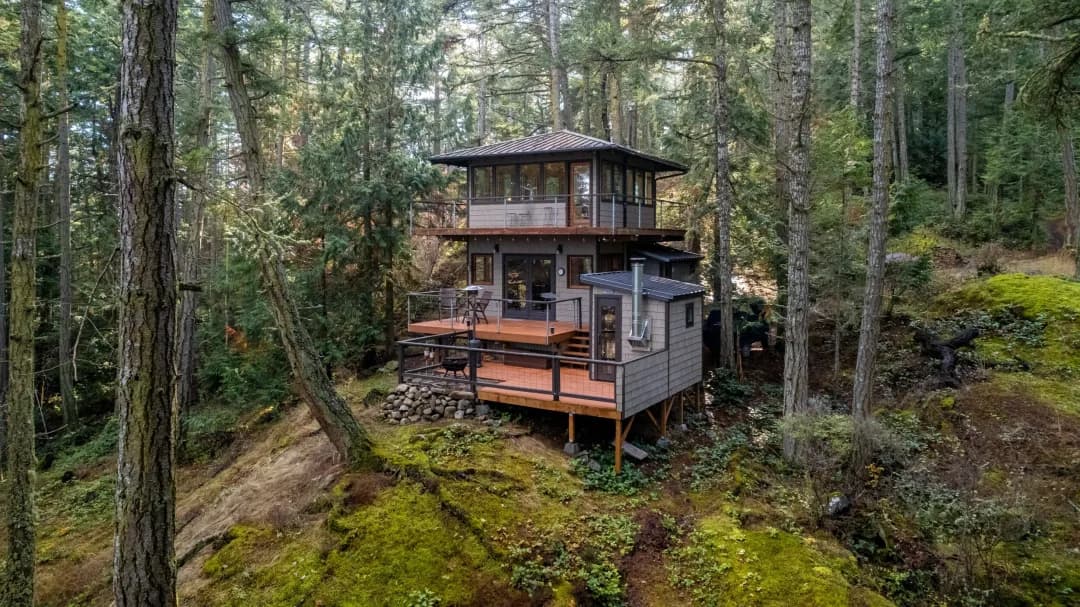
The paradox that defines high-end eco-tourism
The most valuable eco-resort sites are the hardest places to build. That is the whole game. Guests pay a premium to wake up on an alpine ridge in Patagonia, a remote archipelago in the Pacific Northwest, or a forest canopy in Costa Rica. Those same locations are the places a flatbed truck physically cannot reach, where the local soil will not support a crane, and where a lumber delivery would sink into the trail before it arrived.
The economics are real. Grand View Research valued the global glamping market at roughly $3.79 billion in 2025, with a projected 9.5% CAGR through 2033. Global Market Insights models a more aggressive trajectory, from $4.8 billion in 2025 to $13.1 billion by 2035. Millennials own 43.1% of that market today, and Gen Z is the fastest growing segment at 12.2% annual growth.
What that translates into on the ground is developers chasing Average Daily Rates north of $250 per night for unique structures like luxury domes and suspended treehouses, and over $329 per night for ultra-premium sites combining stargazing with wellness integrations. The ROI math works, but only if you can actually build the thing in a remote location without blowing the budget on heavy-haul freight, helicopter drops, and mobile cranes.
Why traditional construction breaks on a remote site
The primary cost drivers on remote eco-resort builds are not materials. They are transportation geometry, labor mobilization, and heavy equipment dependencies. Move Cars heavy equipment transport data puts overland heavy hauling at $2.50 to $5.00 per mile, with complex hauls regularly exceeding $10,000 per trip once you account for pilot cars and oversize load permits.
Marine logistics are worse. Blue Water Concepts documents how barge capacity, weather windows, and ferry limitations can delay island projects for weeks and inflate budgets by 15 to 30% compared to a mainland build. And once the materials finally arrive, you still have the problem of getting them from the beach to the actual build site.
Mobile cranes do not work on soft forest floor, steep mountain slopes, or sandy coastal bluffs. They require flat, highly stable ground for outrigger deployment, or the whole rig can topple. In the locations where an eco-resort actually wants to be, that flat pad does not exist. Renting a crane anyway, if you could get one up the road, runs around $5,000 per day before permits and disruption fees.
And then there is the labor shortage. Stoel Rives reports that the ongoing skilled-trades shortage hits remote projects the hardest, because developers have to pay premium "uplifts" to get certified welders to travel, then build and supply "man camps" to house them. The logistics of feeding and housing a workforce in an off-grid environment eats your margins before the first guest arrives.
What flat-pack aluminum changes about the logistics
Here is the shift that makes high-end eco-tourism financially workable in the first place. Unlike 3D volumetric modules, which are essentially shipping finished rooms filled with air, an aluminum structural frame can be manufactured off-site and shipped as dense 2D flat packs. The entire structural envelope of a luxury cabin fits on a standard flatbed truck or in some cases a consumer pickup.
Flat-packing the structure eliminates the oversize load permits, the pilot cars, and the specialized shipping routes. More importantly, it insulates the developer from heavy-haul freight price volatility, which has been brutal over the past few years.
Once the flat packs arrive at a staging area, the material's weight-to-strength ratio does the rest of the work. Aluminum has structural capacity comparable to steel at roughly a third of the mass, which means the individual framing members can be carried by hand. A small crew can move them down an unimproved trail, through a forest canopy, or along a 36-inch pathway where a vehicle cannot fit. For truly inaccessible sites, helicopters can sling-load the flat packs in.
| Logistical constraint on a remote site | Stick-built wood | Structural steel / 3D modular | Flat-pack bolted aluminum |
|---|---|---|---|
| Transport to staging area | High volume of raw materials. Vulnerable to rain on the trip in. | Oversize loads. Pilot cars, police escorts, permits. | Flat-pack on standard flatbeds or pickup trucks. |
| Access to the actual build site | Wide road required to drop lumber bundles. | Cannot reach most switchbacks or forest trails. | Components hand-carryable through 36-inch pathways. |
| Lifting equipment on soft ground | Telehandlers and small cranes for roof trusses. | 50-ton mobile cranes. $5k+/day rental plus risk of ground collapse. | Portable hand-cranked gantries. Carried in by crew. |
| Labor skill required | Master carpenters for field cuts and complex framing. | Certified welders, riggers, specialized operators. | Small general crew using hex keys, drills, wrenches. |
| Decommissioning and return to nature | Demolition. Landfill. Scars the site. | Welded connections cannot be cleanly disassembled. | Unbolt, carry out, sell the metal for scrap. |
The foundation problem on a cliff or a cedar forest floor
The foundation tends to be the single most destructive part of a remote build. Traditional concrete pads require excavation, grading, cut-and-fill slope work, and the delivery of wet concrete across terrain that does not want to support a concrete truck. All of that damages root systems, alters natural drainage, and violates the Leave No Trace principles that are increasingly the regulatory baseline for eco-tourism.
Because the superstructure of a flat-pack aluminum cabin is so light, you can skip the slab entirely. Two foundation technologies work particularly well with aluminum frames:
- Helical piers. Steel shafts with helical plates that get screwed into the soil using compact hydraulic equipment. Zero excavation, no soil spoils, no concrete curing time. For sloped terrain, battered piles (installed at an angle) provide lateral stability without retaining walls. PierTech's sustainability analysis covers the environmental math in detail.
- Diamond piers. Precast concrete heads with four galvanized steel pins driven diagonally into the earth. No deep excavation, no root damage. Diamond Pier's documentation shows the installation footprint.
The combined effect is that the cabin "steps" with the natural topography, hovering above the forest floor or the cliff edge. When the lease ends or the resort is decommissioned, the frame unbolts, the piers unscrew, and the site goes back to looking like nobody was ever there. That is the actual promise of Leave No Trace architecture, and it only works with a lightweight frame.
I wrote about the physics of building on a slope in more detail in our hillside construction post, and the region-by-region breakdown for hillside terrain in Hawaii to the Smokies. The short version: the lighter the building, the less foundation you need, and the less damage you do to get there.
Salt, wind, fire, earthquakes: the environment is trying to kill your building
Remote eco-resorts get hit with every climate stressor at once. Salt-laden marine air on coastal sites. Heavy snow loads at altitude. Seismic activity along the Pacific Rim. Wildfire risk in forested regions. And the guest expectation is that the cabin looks pristine the entire time.
For coastal builds, the main failure mode is corrosion. Salt air travels up to 50 miles inland and rapidly rots wood and rusts steel. Aluminum forms a self-healing oxide layer on contact with oxygen that makes it functionally immune to marine corrosion. It does not need protective coatings, and scratches during installation re-seal automatically. For hospitality operators this means zero ongoing exterior maintenance, which is a hidden operational cost that most developers underestimate.
For seismic sites, the advantage is mass. Seismic force scales with the mass of the building, so a lighter frame attracts lower earthquake loads. Aluminum is also ductile, which means it can flex and absorb kinetic energy during a shake without brittle fracture. The bolted connections of an engineered aluminum system hold their load-bearing integrity through violent cyclic loading, unlike nailed wood joints that tend to pull out under seismic stress.
For wildfire zones, the advantage is ignition temperature. Aluminum passes ASTM E136 testing as non-combustible and has a melting point around 1,220°F. When encapsulated with mineral wool and magnesium oxide sheathing, these assemblies can hit 60 to 120 minute fire ratings. In many regions, using non-combustible framing qualifies for "Safer from Wildfires" insurance discounts worth up to 16.4% on premiums. I covered this math in detail in our wildfire zone framing post, and the principles apply directly to remote resort development. The same lightweight, hand-deployable, non-combustible framing also turns out to be the structural system FEMA is increasingly funding for post-disaster shelter and emergency operations, where survivors and first responders need infrastructure that can be erected in zero-power conditions without specialized labor.
Why "healthy" is becoming a guest expectation, not a marketing line
The Global Wellness Institute projects the wellness economy will hit $8.5 trillion by 2027. For luxury travelers, sustainability and personal health have fused into a single value. They want the remote location, the organic sheets, the low-VOC paint, and they assume the structural envelope is also clean. In most cases it is not.
Traditional lodge construction uses engineered wood products, OSB, MDF, plywood. These are held together with urea-formaldehyde adhesives that off-gas formaldehyde at rates up to 100 times higher than raw lumber. Formaldehyde is a known human carcinogen. Even untreated softwoods emit terpenes that react with indoor ozone to form ultrafine respiratory irritants. Wood in a humid coastal environment becomes a mold substrate almost immediately, and the mycotoxins produced by Stachybotrys are linked to severe respiratory issues.
Aluminum sidesteps all of it. It contains no adhesives, no resins, no organic fibers, and nothing for fungi to eat. The powder coating used to finish architectural aluminum is solvent-free and emits zero VOCs. The structural envelope of the cabin contributes nothing to the indoor air, which is the exact "source control" strategy the WELL Building Standard v2 prioritizes.
I wrote a much longer analysis of this problem in the hidden carcinogens inside your walls. The short version for resort operators: the marketing says your cabin is a wellness sanctuary, but if the frame is built from OSB and CCA-treated lumber, the marketing is wrong.
The metal problem: thermal bridging and acoustic privacy
Aluminum has two real weaknesses for luxury hospitality applications, and I want to be honest about both. It conducts heat well, and it conducts sound well. Both problems are solvable, but both require intentional engineering.
The heat issue is called thermal bridging. If a continuous aluminum member connects the cold exterior to the warm interior, it becomes a superhighway for energy transfer, bleeding heat and taxing the HVAC. The fix is a "thermal break," which is an insulating polyamide or polyurethane strip extruded into the center of the profile, physically separating the exterior metal from the interior metal. Combined with continuous exterior insulation and high-performance double-paned Low-E glazing, this produces a very tight thermal envelope, which matters especially for off-grid resorts running on solar and batteries. The vertical farm post covers how this same conductivity flips from liability to asset inside a building, where the frame acts as a passive heat sink for LED grow lights.
The sound issue is similar. Sound waves travel through dense solid materials, so a bare aluminum frame can transmit vibration from one room to the next. Hitting a luxury-grade Sound Transmission Class (STC) rating of 50 or higher requires three things: mass (thick sheathing like 5/8-inch MgO board or double drywall), cavity absorption (dense mineral wool or fiberglass, not rigid foam), and decoupling (resilient channels and isolation clips that mechanically detach the interior surface from the studs). Done properly, the finished assembly outperforms most traditional hospitality construction on acoustic privacy.
The glamping economics, compressed
Here is the part that tends to decide whether a project gets financed. Pre-engineered structures can be deployed and operational in a fraction of the time of a traditional build. Developers often report full ROI within a single busy season, which is borderline unheard of in hospitality.
The reason is speed. A flat-pack aluminum cabin can go from staging to weather-tight in days, not months. There is no waiting for welders, no waiting for a crane rental window, no waiting for concrete to cure. You compress the build window down to where the cabin is collecting nightly rates before the next season starts.
Average Daily Rate by eco-cabin typology (USD)
What I tell developers who are evaluating remote builds
When someone asks me whether aluminum framing makes sense for an eco-resort project, the decision usually comes down to three questions. Can you get traditional materials and equipment to the site without blowing the budget? Can you stay on the right side of Leave No Trace or similar environmental mandates with a concrete slab foundation? And can you secure insurance for a combustible wood structure in a wildfire zone at a price that makes the project pencil out?
For most of the sites I look at, the answer to at least two of those is no. That is where flat-pack aluminum stops being a design preference and starts being the only viable building method.
Working on an eco-resort or glamping project in a hard-to-reach location?
Khurshid has helped developers figure out how to build on cliffs, islands, and forest ridges where nothing else pencils out. Give him a call.
Call Khurshid: (650) 450-1455Sources
- Grand View Research - Glamping Market Size & Trends
- Global Market Insights - Glamping Market Forecast 2035
- Forbes - How Glamping Is Reshaping Luxury Travel
- Blue Water Concepts - Remote Island Build Challenges
- Move Cars - Heavy Equipment Transport Cost Guide 2025
- Stoel Rives - Construction Labor Shortages
- PierTech - Helical Piers for Sustainable Foundations
- Diamond Pier - Conditions and Uses
- Wilderness Destinations - How We Build Safari Camps
- Hospitality Design - Wellness Industry Outlook
- FDomes - ROI of Glamping