Aluminum framing for vertical farms: why wood and galvanized steel fail inside a CEA facility
Vertical farms run at 80% humidity, pH-5.5 hydroponic mist, and 24/7 LED heat. Wood rots. Steel rusts and leaches zinc into your water. Every welding day is a biosecurity event. Here is what the material science actually says.
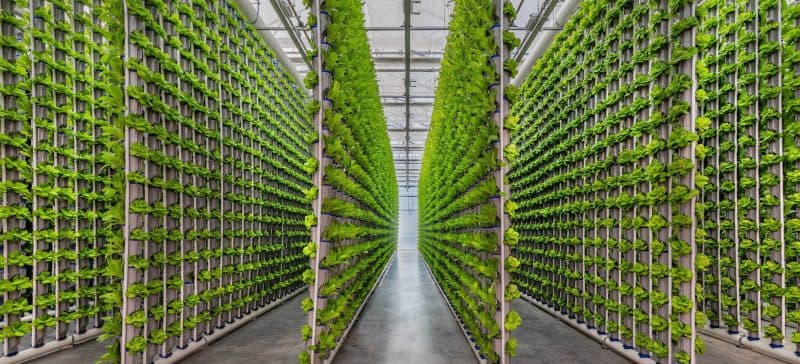
A vertical farm is not a warehouse
The first time I toured a commercial vertical farm, I was struck by how unfamiliar the room felt. Not because of the LEDs or the racks, but because the air had weight. The humidity sits around 70 to 80% for most of the grow cycle. The lighting runs hot enough to warm the structure. And the walls are constantly being sprayed or misted with nutrient solutions that are deliberately acidic, usually pH 5.5 to 6.5, so the roots can take up minerals.
If you walk into that environment thinking you are building a warehouse, you are going to watch your structure fail in real time. Wood absorbs the humidity and starts rotting within a season. Galvanized steel looks fine for a year or two, then the zinc coating begins dissolving in the acidic mist, and pretty soon you have brown streaks running down your beams and elevated zinc in the reservoir.
Vertical farming is projected to grow fast. Grand View Research puts the North American market at 33.4% of global share in 2025, and the AgroFOOD Industry Hi Tech review shows Chinese CEA expanding at a 27.9% CAGR through 2029. That money is going to build a lot of facilities, and a lot of them are going to be built with the wrong materials.
Why the humidity problem is worse than it sounds
Plants are biological humidifiers. Through transpiration, a single square meter of lettuce canopy can release several liters of water vapor per day. In a multi-story grow room packed with tens of thousands of plants, that adds up to enormous volumes of moisture that the HVAC has to pull out of the air around the clock.
Here is the part that tends to catch operators off guard. As the LED cycle turns off and the room cools during the dark period, the air's ability to hold water vapor collapses. If dehumidification cannot keep up, the air reaches its dew point and moisture condenses on the coldest surfaces in the room. Those cold surfaces are usually the structural framing overhead.
When condensation forms on a beam above a crop canopy, the droplets fall. If the drop has been carrying fungal spores or bacteria (and in a wood frame it will be), the structure has just become a delivery mechanism for disease. IntechOpen's humidity optimization review describes this cycle as one of the primary vectors for Botrytis cinerea (gray mold), powdery mildew, and downy mildew in CEA operations. Once those pathogens take hold, an entire cultivation module can be lost in days.
What happens to wood inside a grow room
Wood is hygroscopic, which is a clean way of saying it acts like a sponge. At 80% relative humidity, untreated pine starts absorbing ambient moisture immediately. Within a season, you get warping, joint splitting, and deep fungal rot. Even treated wood, like redwood or cedar, requires constant chemical sealing and inspection to avoid structural failure.
The bigger problem is biological. Wood has a porous cellular structure that harbors bacteria and fungi deep inside the material, below the surface where any sanitizer or UV lamp can reach. The Nordisk Industrifond 2002 hygiene study on wood in food-processing environments documented why large parts of the food industry long ago banned wood from any area exposed to moisture or raw biologicals. When your final product is a ready-to-eat bag of lettuce, a wood frame is a liability, not a structural asset.
I have written more about the chemistry of wood-based indoor pollution in the hidden carcinogens inside your walls. For a residential home the stakes are chronic, long-term exposure. For a food production facility the stakes are immediate crop contamination and regulatory failure.
Why galvanized steel is the trap nobody talks about
Galvanized steel gets chosen for vertical farms because on paper it looks like the safe option. It is strong, rust-resistant, and every structural engineer already knows how to work with it. The issue is that galvanization is a conditional coating. The zinc layer is amphoteric, which means it only holds up in chemically neutral environments. Once the ambient pH drops below about 5.5, the zinc starts dissolving.
And in a vertical farm, the ambient pH is almost never neutral. Hydroponic and aeroponic systems are tuned to 5.5 to 6.5 on purpose, because that is the pH range where roots absorb nutrients most efficiently. Aerosolized nutrient mist drifts through the air, lands on the beams, and slowly strips the zinc. Over time the steel rusts, the beams stain, and the dissolved zinc ends up in the water loop.
Zinc is an essential micronutrient, but only in trace amounts. Above roughly 0.1 ppm in a hydroponic reservoir, it becomes toxic to the crop, inhibiting root function and halting photosynthesis. In an aquaponic system, the problem is worse. Zinc concentrations between 4 and 8 ppm are lethal to the aquaculture fish that provide the nutrient base. A single contaminated structural member leaching zinc into a closed loop can wipe out an entire production run.
How aluminum behaves in the same room
Aluminum does not rely on an applied coating. When raw aluminum hits oxygen, it forms a microscopic layer of aluminum oxide on the surface within milliseconds. That layer is inert, tightly bonded, and self-healing. Scratch it during installation and it re-forms. Spray acidic mist on it for years and it holds.
The metallurgical term is passivation, and it is the reason aluminum is used for marine hulls, pharmaceutical processing equipment, and pretty much any application where a structural metal has to sit in a corrosive atmosphere for decades. Long-term comparison testing routinely shows aluminum outperforming galvanized steel in continuous humidity, with negligible degradation over decades of exposure.
For CEA specifically, aluminum solves three problems at once: it resists the acidic hydroponic aerosols, it does not leach heavy metals into the water system, and the smooth oxide surface resists microbial adhesion. Under advanced treatments like titanium-oxide anodizing, aluminum even exhibits measurable bactericidal effects against E. coli, Listeria, and Salmonella. The structural frame becomes a passive biosecurity layer rather than a contamination source.
| Failure mode inside a CEA facility | Dimensional wood | Galvanized steel | Extruded aluminum |
|---|---|---|---|
| Moisture absorption at 80% RH | Hygroscopic. Absorbs water, swells, warps, rots. | Forms surface condensation that pools and drips. | Non-porous. Does not absorb moisture. |
| Biosecurity and sanitation | Porous cellular structure. Harbors deep bacterial reservoirs. Banned in most food-contact zones. | Pitting and flaking creates microscopic harbors for biofilms. | Smooth oxide surface. Resists microbial adhesion. Compatible with caustic sanitizers. |
| Exposure to pH 5.5 hydroponic nutrients | Not applicable. Structure already rotting before this matters. | Acidic nutrients dissolve the zinc coating. Zinc leaches into the reservoir. | Self-healing aluminum oxide layer resists acidic aerosols. |
| Risk to hydroponic crops and aquaponic fish | Mold spores enter the canopy. Stachybotrys and powdery mildew outbreaks. | Zinc toxicity in crops above 0.1 ppm. Lethal to fish at 4 ppm. | No heavy metal leaching. No organic substrate for fungi. |
| Thermal interaction with LED racks | Insulating, so heat pools around fixtures and stresses plants. | Conducts heat poorly compared to aluminum. Hot spots persist. | 4x the thermal conductivity of steel. Acts as a passive heat sink for LEDs. |
| Expanding a facility adjacent to live crops | Hammering, sawing, sawdust contamination. | Welding sparks and slag. Biosecurity breach. | Quiet bolted assembly. No sparks, no hot work. |
The thermal bonus: aluminum as a heat sink for LED arrays
There is a second property of aluminum that makes it unusually well suited to vertical farming, and it has nothing to do with corrosion. Aluminum has roughly 4 times the thermal conductivity of steel. In a grow room, that is a gift.
Full-spectrum LED grow lights are efficient, but they still generate significant localized heat. In a multi-story stack, thousands of fixtures are mounted inches above delicate plant canopies. If that heat is not evacuated, the plants cook. Most LED fixtures rely on internal fans to move heat away from the diodes, and mechanical fans are the first thing to fail in a dusty, 80% humidity environment.
When you mount those LED fixtures to an aluminum structural frame, the frame itself becomes a passive heat sink. Heat moves from the diodes into the extrusion, along the length of the beam, and out into the ambient airflow. You get longer fixture life, fewer hot spots above the canopy, and a more uniform microclimate for the crops. It also means the structure stays closer to ambient room temperature, which reduces the condensation problem I described earlier. The frame is no longer the coldest surface in the room, so water vapor stops targeting it first.
What about thermal bridging?
I would be dodging an obvious question if I did not address this. Aluminum conducts heat roughly four times better than steel, and I just spent a section explaining why that is a gift for LED cooling. But the same property means aluminum framing can act as a thermal bridge, conducting heat through the building envelope faster than the insulated wall or roof panel around it.
This is not unique to aluminum. It is a property of every metal structural system, steel included. The difference is how you deal with it.
In a Core X Frame assembly, the posts and beams are insulated with thermal breaks that interrupt the conduction path through the envelope. And the framing itself accounts for roughly 3% of the total wall surface area, so the actual thermal bridging exposure is small relative to the insulated field of the wall. The combination of targeted insulation on a minimal contact area keeps the envelope performance where it needs to be.
For a vertical farm specifically, this tradeoff is even more favorable than it sounds. The thermal conductivity that could work against you at the envelope is the same property that works for you inside the grow room, pulling heat away from LED fixtures and keeping the frame closer to ambient temperature so condensation does not form on the beams overhead. You are managing one property in two directions, and insulation at the envelope is the tool that lets you have it both ways.
Why the load path matters even more in a vertical farm
Most commercial vertical farms want to put racking, catwalks, and automation robots in every square foot of the floor. Interior columns break that up. They force robots to route around obstacles, fragment the racking layout, and create dead zones where lighting and irrigation cannot reach efficiently.
Advanced aluminum framing systems move the structural load to the exterior envelope, which frees the interior completely. I wrote about this principle in the context of residential design in no load-bearing walls, but the implications are arguably bigger for CEA than for housing. A clear-span grow hall lets you run uninterrupted racks the length of the building, deploy automated mobile robots without complex routing algorithms, and reconfigure the entire layout when you pivot crops without touching the structure.
The same clear-span approach also improves airflow. Interior columns act as baffles that fragment HVAC circulation, create stagnant air pockets, and cause vapor-pressure-deficit spikes that stress plants. When the structural system is entirely perimeter-loaded, high-volume circulation fans can sweep the room evenly. Laminar airflow is not a luxury in a vertical farm. It is the difference between healthy crops and a mold outbreak.
The welder problem, in a farm that cannot stop
Every time someone welds structural steel, the environment around that weld becomes a hazard zone. Sparks, slag, toxic fumes, and UV flash. OSHA classifies it as "hot work" and requires fire watches, ventilation, and the removal of combustibles within a wide radius. None of those things are compatible with a live grow room full of plastic trays, fertilizers, and high-voltage wiring.
Bolt-together aluminum framing gets you out of welding entirely. The components are extruded to spec, flat-packed, and assembled with hex keys, drills, and wrenches. No sparks, no slag, no hot work permits. That is what lets operators expand a facility immediately adjacent to a live cultivation bay without contaminating it.
The timeline difference is bigger than I expected when I first ran the numbers. Based on industry comparisons, a general labor crew of 20 to 50 people can frame a 30,000 square foot facility using bolted aluminum in 14 to 21 weeks. A comparable multi-story steel build runs 31 to 45 weeks, and that is assuming you can even find certified welders, which right now you probably cannot. The ITIF reported in January 2026 that the construction industry is short roughly 439,000 workers, with welders among the hardest trades to fill. Our data center framing post covers how the same shortage is reshaping commercial construction in general, and the luxury pop-up pavilion post shows how the same hot-work avoidance is now mandatory for premium event venues that will not grant welding permits.
Framing a 30,000 sq ft multi-story vertical farm (weeks)
Weight is the other reason aluminum wins the urban site
A lot of the most interesting vertical farming projects involve retrofitting old urban warehouses or stacking grow halls into dense city sites. Both of those things push hard on foundation capacity. Steel framing weighs enough that every additional floor requires deep foundation reinforcement, and in seismic regions, the inertial load of a heavy superstructure becomes its own problem.
Aluminum weighs roughly 65% less than steel at equivalent structural capacity. That weight reduction cascades down through the foundation. Smaller piers. Less rebar. Lower seismic loads. Research on concrete-filled aluminum alloy tubular (CFAT) columns has shown self-weight reductions of 17 to 47% compared to traditional steel tubes at identical load capacity, and lifecycle cost analyses put the total cost of an aluminum-framed structure at roughly 29% below steel once maintenance downtime is factored in.
For an urban retrofit, this is often the deciding constraint. You cannot always reinforce an existing warehouse foundation cost-effectively, so the only way to add vertical farming capacity inside an old building is to use a lighter structural system.
What a realistic CEA operator should be asking
If I were evaluating a structural system for a new vertical farm today, I would ask five questions, in this order:
- Will the frame survive 80% RH and pH-5.5 nutrient exposure for 20 years without recoating or replacement?
- Will it leach any metals into a closed hydroponic or aquaponic loop?
- Can I expand the facility without welding next to a live cultivation bay?
- Can I build clear-span halls that accommodate the robotics I am going to install two years from now?
- At end of life, does the material have real salvage value, or does it become landfill?
Bolted aluminum framing is the only structural system I have looked at that answers yes to all five. Architectural aluminum is infinitely recyclable, and recycling it takes 95% less energy than making new aluminum from bauxite, according to the EPA's aluminum data. At the end of a facility's life, an operator can unbolt the frame, sell the aluminum into the recycling market, and recover real value. You cannot do that with welded, rusted steel.
The material is the biosecurity system
This is the part I find most interesting, honestly. In most industries, we think of biosecurity as a layer of sanitation protocols bolted onto an otherwise passive building. In a vertical farm, the building itself either helps or hurts the biology. A porous, hygroscopic, chemically reactive structural frame is a permanent contamination source. A smooth, inorganic, passivated frame is a permanent contamination suppressor.
When people ask why I keep pushing aluminum for CEA, that is the answer. The structure is not neutral. You either picked a frame that fights you for 20 years or one that quietly helps you run a cleaner farm.
Planning a vertical farm build and looking at structural options?
Khurshid has walked plenty of CEA sites. If you want a candid conversation about aluminum framing for your facility, no pitch deck required, give him a call.
Call Khurshid: (650) 450-1455Sources
- Grand View Research - Vertical Farming Market Size & Share
- MDPI Horticulturae - What You May Not Realize about Vertical Farming
- Coairo - Humidity Management in Vertical Farms
- IntechOpen - Humidity Optimization in Greenhouses
- Nordisk Industrifond - Wood, Plastic and Steel Hygienic Properties
- PMC - Survival of Bacterial Strains on Wood Compared to Aluminum and Steel
- AngleLock - Aluminum Frame Design vs Light Structural Steel
- ITIF - Construction Industry 439,000-Worker Shortage (Jan 2026)
- Quality Structures - Greenhouse Frame Materials: Steel vs Aluminum vs Wood
- EPA - Aluminum Recycling Data