Modular aluminum framing for disaster relief: a faster, healthier alternative to FEMA trailers and shipping containers
A FEMA manufactured housing unit costs $110,000 to $129,000 for 18 months of shelter. Shipping containers need 50-ton cranes that the disaster zone does not have. There is a third option, and FEMA's BRIC grant program is now actively funding it.
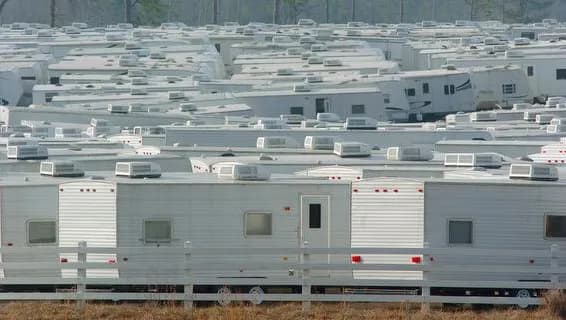
The math on FEMA temporary housing has been broken for a long time
When a disaster wipes out a community, FEMA's standard playbook for physical shelter relies on manufactured housing units. They are pre-built on a temporary steel chassis under HUD's national code, and the agency procures them at scale because the supply chain already exists. On paper this looks efficient.
The real numbers are harder to look at. According to the MIT Humanitarian Supply Chain Lab's disaster housing report, deploying a single manufactured unit costs the federal government somewhere between $110,000 and $129,000, and the Stafford Act caps temporary housing assistance at 18 months. That is roughly $120,000 in capital for a year and a half of shelter, after which the unit is sold or scrapped and the survivor has to find somewhere else to live.
The logistics are the other half of the problem. A finished manufactured home is essentially an empty box on wheels. Shipping it to a disaster zone means wide-load transport, pilot cars, and unobstructed roads, none of which exist in the immediate aftermath of a hurricane that washed out the bridges or an earthquake that buckled the highways. So you end up with a stockpile of expensive trailers parked at a staging area waiting for the road to be cleared, while survivors are still sleeping in school gyms.
Why shipping containers also fail in real disaster conditions
For the past decade or so, the disaster relief space has flirted heavily with modified ISO shipping containers as a faster and cheaper alternative. Corten steel is durable, properly anchored containers can resist 175 mph winds, and there is a global supply of empty boxes available at any port. It looks like a clean solution.
The problems show up the second you try to move one. A standard 40-foot container weighs around 8,000 pounds empty and requires high-capacity cranes and container handlers for offload. In a disaster zone, that heavy machinery has either been destroyed, commandeered for debris clearing, or cannot reach the site because the access roads are gone. An emergency shelter that requires a 50-ton crane to deliver is functionally useless in the conditions where you actually need it.
The conversion math is also worse than people expect. To make a container habitable, crews have to cut large openings for doors, windows, and ventilation, which immediately compromises the shear strength of the corrugated walls. Each cut requires welded steel bracing to restore structural capacity, which means you need certified welders, heavy power tools, and big diesel generators on a site that has no electricity. And steel is a thermal bridge, so the box becomes an oven in summer and a freezer in winter unless you add thick closed-cell foam insulation, which eats most of the interior space and introduces VOC off-gassing in the very environment you are trying to make safe.
The hidden carcinogen problem in temporary housing
This is the part of disaster response that I think gets too little attention. Survivors arriving in temporary housing are not in a normal physiological state. They are often immunosuppressed, dealing with respiratory irritation from smoke or pulverized concrete, and carrying significant psychological trauma. Putting them into a structure that off-gasses formaldehyde, breeds mold, and sheds chemical flame retardants into household dust is a public health failure on top of a natural disaster.
Standard residential wood framing and conventional manufactured housing carry at least 55 chemicals of concern in their structural materials. Engineered wood products like OSB, plywood, and MDF are bonded with urea-formaldehyde adhesives that release formaldehyde at rates up to 100 times higher than raw lumber. After a flood or a hurricane, wood framing in a damp environment becomes a substrate for Stachybotrys chartarum (black mold), which produces mycotoxins linked to severe respiratory issues and pulmonary hemorrhage in infants.
I went deep on the chemistry of this in the hidden carcinogens inside your walls. The takeaway for emergency response: the framing material is the largest source of indoor contamination in any home, and deploying wood-framed housing into a disaster zone means actively exposing already-vulnerable people to known carcinogens and neurotoxic flame retardants.
Aluminum is inorganic, non-porous, and chemically inert. It contains no adhesives, no resins, no synthetic flame retardants, and nothing organic for fungi to colonize. The powder coating used to finish architectural aluminum is solvent-free with zero VOC emissions. For survivors with multiple chemical sensitivity, asthma, or compromised lungs, the difference is immediate and tangible.
What changes when the structure flat-packs and hand-assembles
The technology that actually shifts the disaster response calculus is precision-engineered, flat-pack aluminum framing. The system relies on factory-cut, computer-milled components that ship as dense flat packs and bolt together on site without welding, adhesives, or pneumatic fasteners.
Geometrically, the difference is significant. A single commercial flatbed truck can carry the structural framing for multiple medical clinics or dozens of housing units, because you are not paying to ship empty air. When ground transport is impossible, the same flat packs can be sling-loaded under helicopters and air-dropped into the epicenter of the crisis. That is a tactical move you simply cannot execute with manufactured trailers or 8,000-pound steel containers.
Once the materials arrive, the assembly is the part that surprises people. The system uses standardized panels, zinc-plated bolts, locking plates, and precision-cut components that only fit one way. Quality assurance is embedded in the geometry: the locking clips physically will not engage unless the parts are seated correctly, which prevents most assembly errors by unskilled workers. A small team of local volunteers, displaced residents, or international aid workers can erect the structural frame using nothing more than hand tools, in a zero-power environment, in roughly a third of the time required for traditional wood framing.
There is a thermal performance angle here that ties back to the container problem. I mentioned that steel containers are thermal bridges, ovens in summer, freezers in winter. Aluminum conducts heat even better than steel, so the same concern exists on paper. In practice, thermal breaks built into the frame profiles and continuous insulation in the wall assembly handle it. In a zero-grid environment where survivors have no air conditioning or heating, the thermal envelope is the only thing between them and the weather. Getting that right with minimal material and no specialized labor is part of why bolt-together aluminum framing fits this application. The vertical farm post covers the physics of managing aluminum's conductivity in both directions.
| Post-disaster constraint | FEMA manufactured housing | Shipping container conversions | Bolt-together aluminum |
|---|---|---|---|
| Cost for ~18 months of shelter | $110,000 - $129,000 per unit | $45,000 - $80,000 plus modification | Reusable across multiple events; cost amortizes per deployment |
| Transport to a damaged road network | Wide-load truck. Needs clear roads and pilot vehicles. | Flatbed plus crane for offload. Cannot navigate switchbacks. | Flat-pack on a standard truck or sling-loaded under a helicopter. |
| Assembly in a zero-power environment | Pre-built. No assembly needed, but cannot reach the site. | Requires welders, generators, angle grinders. | Hex keys, drills, hand tools. Local volunteers can build it. |
| Indoor air quality for vulnerable survivors | Engineered wood components off-gas formaldehyde from UF adhesives. | Steel cooks in heat, freezes in cold. Insulating it adds VOCs. | Inorganic, non-porous, no off-gassing, no mold substrate. |
| End-of-deployment fate | Trailer is sold off or scrapped. Federal capital lost. | Container is sold or stored. Modifications devalue it. | Unbolt and reconfigure. Same components become a school annex or community center. |
| Stafford Act 18-month temporary housing cap | Hits the cap, then survivor has to relocate. | Hits the cap, then container has to move. | Can be progressively transitioned to a permanent foundation as real property. |
The clinical use case: emergency medical infrastructure
When local hospitals are damaged or overwhelmed, mobile and modular health units become the primary mechanism for triage and trauma response. The technical specifications for these facilities are not relaxed because of the emergency. USACE space planning criteria require an emergency department to include at least two ED treatment rooms, one Airborne Infection Isolation (AII) room, one bariatric room, and two Level I/II Trauma and Resuscitation bays. International Sphere Standards for humanitarian response require strict patient confidentiality, meaning open-air tent triage cannot meet the bar.
Modular aluminum wall panels can be configured into rigid, sound-dampened interior partitions that hit Sound Transmission Class ratings between STC 46 and 58, which is enough to satisfy patient privacy requirements that simply cannot be met inside a tent or a soft-sided military structure. The frame itself can support suspended medical equipment, overhead surgical lighting, and the heavy HVAC ducting required to create the negative-pressure environments needed for AII isolation.
The other clinical advantage is sanitation. Aluminum does not harbor bacteria the way porous materials do, and the structural envelope can be subjected to caustic chemical sanitizers without degrading. A field clinic built on an aluminum frame can hold clinical hygiene standards in the most contaminated post-disaster environment.
Progressive sheltering, and the Stafford Act problem
The 18-month cap on temporary housing assistance is one of those policy details that creates real human suffering. When the cap is reached, the survivor has to leave the temporary unit, and the unit gets returned to the federal stockpile or scrapped. Meanwhile, the survivor's actual home is often still in the middle of being rebuilt.
The Advanced Modular Housing (AMH) concept developed under HUD-funded research takes a different approach. Instead of one-size-fits-all manufactured boxes, AMH uses sequential modules: a 160-square-foot "Core" unit with kitchen, bath, laundry, and sleeping loft that deploys immediately on rough terrain with minimal foundation prep, then 193-square-foot "Space" modules that bolt directly to the Core to add bedrooms or sleeping porches, and eventually a "Dwell" module that brings the whole structure to a 1,147-square-foot multi-bedroom home on a permanent foundation.
This sequence is only possible with a lightweight, bolt-together structural system. Manufactured trailers cannot be expanded after delivery. Containers can be stacked but not modularly grown. Aluminum framing can. And once the structure is on a permanent foundation, it legally becomes real property, which means the survivor can finance it through traditional 30-year fixed-rate mortgages instead of predatory 7.5 to 10% chattel loans that come with manufactured homes classified as personal property.
For terrain considerations, the same lightweight framing that makes hillside builds work also makes it possible to drop a Core unit on debris-strewn or uneven ground using helical piers or adjustable shims, without the heavy excavation that traditional foundations require.
BRIC funding: federal money is now flowing toward this approach
For the FY 2024/2025 cycle, FEMA announced $1 billion in funding through the Building Resilient Infrastructure and Communities (BRIC) grant program, with $81 million specifically earmarked for adopting hazard-resistant building codes. The BRIC program covers 75% of project costs, leaving local entities responsible for only 25% in cash or in-kind contributions.
What makes this relevant for modular aluminum framing is the program's strict focus on "ready to implement" infrastructure. FEMA has been progressively cutting the slow phased project delays and arbitrary scoring hurdles that used to slow down BRIC awards, specifically to push funding faster to construction projects that can break ground without months of redesign. A pre-engineered, flat-pack, factory-cut aluminum modular system is essentially the reference example of "ready to implement."
The BRIC scoring criteria also reward non-combustible, hazard-resistant construction, which matches the same logic I covered in our wildfire zone framing post: aluminum passes ASTM E136 as non-combustible, does not feed wildfire, and qualifies for "Safer from Wildfires" insurance discounts up to 16.4% on premiums. For a community that has just lost most of its housing stock to a wildfire, the path to BRIC funding plus aluminum framing is genuinely faster than rebuilding with the same combustible wood that burned the first time. The same non-combustible framing logic is also reshaping the remote luxury eco-resort market, where many of the most coveted sites are in WUI fire zones that can no longer get insured at all without it.
FY 2024/2025 BRIC funding allocation (USD millions)
Procurement compliance: the audit-proof argument
Federal disaster spending is heavily audited. As of October 1, 2024, FEMA updated its procurement guidelines under 2 C.F.R. §§ 200.317-200.327, which determine how state, local, tribal, and territorial governments can acquire goods and construction services using FEMA Public Assistance funds. Non-compliance with these standards is one of the top reasons FEMA claws back funding from local governments years after a disaster.
Pre-engineered modular aluminum systems benefit from this regulatory environment in a specific way. Local governments can establish pre-negotiated, competitively bid contracts with manufacturers before a disaster event, locking in transparent fixed pricing that holds up in any audit. That avoids the chaotic emergency purchasing that happens during a crisis, when prices spike and competitive bid requirements get bent or ignored.
Compare that to wood framing, where post-disaster lumber prices in the affected region routinely spike 30 to 50% within days, or to manufactured housing, where the supply chain bottlenecks immediately and pricing is anything but predictable. Factory-cut aluminum components manufactured in a controlled environment under fixed commodity pricing are not immune to inflation, but they are far more predictable than anything sourced from a disaster-affected commodity market.
What happens to the structures when the emergency ends
The conventional disaster response model is destructive. FEMA trailers and cheap temporary wood structures end up in landfills once the recovery period is over. The federal capital is gone, the materials are gone, and the survivors have nothing physical to show for the spending other than whatever permanent home they eventually rebuild.
The aluminum approach inverts this. Because the entire structure is bolted rather than welded or nailed, a temporary triage clinic deployed during a hurricane can be unbolted months later, transported to a different site, and reassembled as a permanent community center, school annex, or pre-positioned stockpile for the next emergency. The same structural components that housed displaced families during a wildfire recovery can become workforce housing for the rebuild crews, and then later become permanent low-income housing on the same lot.
This is the part where the federal capital actually compounds. A $1 million BRIC grant that funds a one-time wood-framed temporary shelter generates 18 months of value and then becomes landfill. The same $1 million spent on a bolt-together aluminum system generates 18 months of immediate emergency value, then gets reconfigured into a permanent civic asset that serves the community for decades. Aluminum is also infinitely recyclable, with recycling requiring 95% less energy than smelting from raw bauxite, so the salvage value at true end-of-life is significant.
The case I would make to a county emergency manager
If I were sitting across from a county emergency management director planning their disaster preparedness investment, the argument would be pretty simple. The traditional approach is expensive, slow to deploy in the conditions where you actually need it, and produces structures that harm the people they are meant to protect. The alternative is a structural system that flat-packs onto standard trucks, hand-assembles in zero-power conditions, qualifies for federal BRIC funding, and converts from temporary shelter to permanent civic infrastructure without throwing the federal investment in a landfill.
The case is not that aluminum framing is the only answer. It is that the legacy options have failed enough times that "we have always done it this way" is no longer a defensible procurement strategy.
Working on a disaster preparedness plan or BRIC application?
Khurshid talks regularly with emergency managers, NGOs, and state procurement officers about modular aluminum framing for disaster response. Call for a conversation, no pitch deck.
Call Khurshid: (650) 450-1455Sources
- MIT Humanitarian Supply Chain Lab - Disaster Housing Construction Challenges
- FEMA - Transitional Sheltering Assistance Quick Reference Guide
- FEMA - Building Resilient Infrastructure and Communities (BRIC)
- HUD USER - Advanced Modular Housing for Post-Disaster Use
- USACE - Temporary Housing Information Paper
- DoD Space Planning - Emergency and Ambulance Services
- FEMA - Protecting Manufactured Homes from Floods and Other Hazards
- Construction Leaders - Modular Construction Transforms Disaster Recovery
- PMC - Use of Mobile Health Units in Natural Disasters: A Scoping Review
- EPA - Aluminum Recycling Data