Aluminum framing for self-storage: how bolt-together construction shortens lead times and pulls lease-up revenue forward
PEMB is the 95% default for self-storage. The three places it costs operators the most money in 2026 are steel mill lead times, condensation in climate-controlled space, and the recoat cycle on coastal facilities. Aluminum framing changes the math on all three.
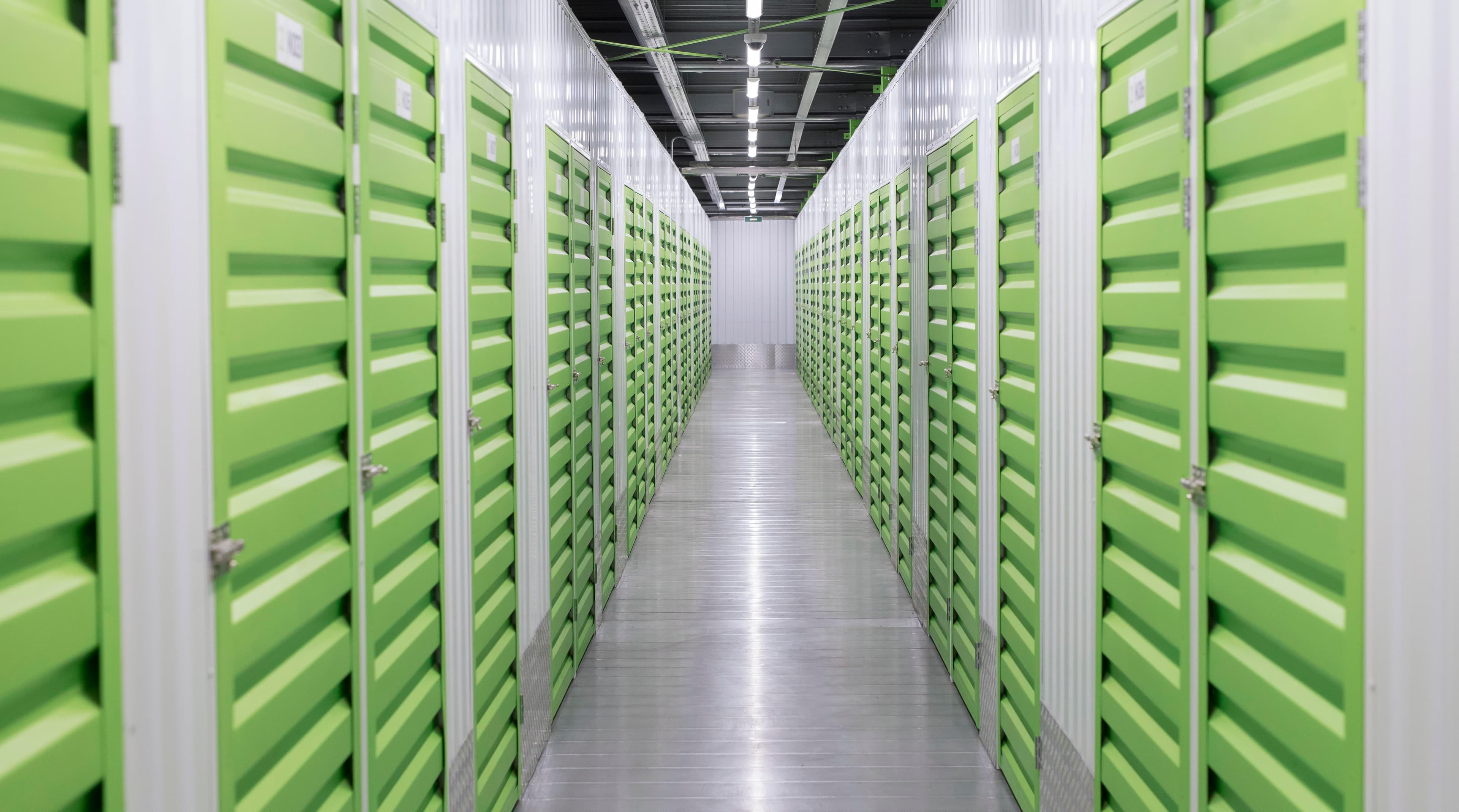
The PEMB default and why operators are starting to look past it
There is a quiet thing happening in self-storage development right now that nobody talks much about on the conference panels. The bottleneck used to be the entitlement process. Now it is the steel.
Pre-engineered metal building (PEMB) kits became the 95% default in self-storage for reasons that made sense in 2010. Clear-span economics. Roll-up door compatibility out of the box. A handful of fabricators (Mako Steel, Trachte, BETCO, Steel Storage) who specialize in the storage layout and ship turnkey packages with door framing already cut for Janus or DBCI. If you were building a single-story drive-up in 2015, PEMB was the right answer and the alternative was a 25% premium for tilt-up concrete.
What changed since then is mostly external to the storage business. Hot-rolled steel coil opened 2026 around $970 per ton, up from roughly $640 in early 2024. PEMB kit prices follow the coil index. Standard PEMB design and fabrication runs 8 to 14 weeks from purchase order. Conventional structural steel for the multi-story climate-controlled segment runs 20 to 26 weeks (Inner Loop Construction industry data). Field-welded assemblies on those multi-story facilities are now a scheduling problem on top of a cost problem, because the construction industry is short roughly 439,000 workers and structural welders are getting redirected to higher-margin data center and LNG work. I covered the same labor pipeline issue in our data center post; the dynamic is the same here.
Coastal climate-controlled facilities built between 2008 and 2015 are entering exterior recoat windows now, and the bills are larger than most pro formas modeled fifteen years ago. None of this kills PEMB. It is still a defensible answer for a lot of suburban single-story drive-up sites in dry climates. But the storage development pipeline in 2026 is dominated by climate-controlled multi-story in the Sun Belt and the urban coasts, and that is exactly the segment where the PEMB defaults stop holding.
Bolt-together aluminum framing is the alternative most developers have not actually priced. This post is about whether they should.
The line items aluminum framing changes
Here is the line-item comparison for a 60,000 square foot, three-story climate-controlled facility. That size is roughly the median in the 2024 to 2026 development pipeline by square footage. The numbers below are representative of quotes I have seen on actual projects, not firm pricing for any specific site.
| Cost line item (60,000 sq ft, 3-story climate-controlled) | PEMB / conventional steel | Bolt-together aluminum |
|---|---|---|
| Frame kit lead time from purchase order | 14 to 26 weeks | 6 to 10 weeks |
| Field welding required | Yes, at multi-story splices and door framing | None |
| Crane or rigging required | Yes, for column lifts | Optional. A standard telehandler covers most of it. |
| Erection labor market rate | $7 to $12 per sq ft (specialty steel erector) | $3 to $5 per sq ft (general framing crew) |
| Coastal recoat cycle (galvanized exterior) | 12 to 15 years within 5 miles of saltwater | None. Self-passivating oxide layer. |
| Janus, DBCI, Trac-Rite roll-up door compatibility | Yes | Yes, identical opening dimensions |
| HVAC compatibility for climate-controlled space | Standard | Standard |
| Non-combustible construction (Type II IBC) | Yes | Yes (ASTM E136) |
| End-of-life salvage | Scrap steel market | Aluminum recycles at 95% less energy than new |
The two lines that move the most money on the pro forma are lead time and erection labor. The other lines are real but mostly affect the year-15 maintenance budget rather than year-1 IRR. I will spend most of the rest of this post on the lines that compound.
Cost per square foot, by facility type
The conversation gets more useful when you separate the three facility types developers actually build, because the framing decision lands differently on each.
Single-story drive-up runs $25 to $42 per square foot for the building package and erection (Steelco Buildings 2026 cost guide, Terrapin Construction Group). All-in development cost (site work, soft costs, drives, fencing, gate, lighting) lands at $35 to $55 per square foot in most markets, with Southeast and Texas at the low end of that range. This is the segment where PEMB is hardest to dislodge. Aluminum's structural advantages over galvanized steel matter least at one story, the door compatibility is identical either way, and the lead time premium for steel is less painful when the project is only nine months from groundbreak to first paid unit.
Climate-controlled single-story is $42 to $70 per square foot for the building package, plus $8 to $15 per square foot for the HVAC system. All-in lands at $55 to $95 per square foot. This is where the condensation problem starts to bite, and it is where aluminum starts to make a real case.
Multi-story climate-controlled is $55 to $95 per square foot in Sun Belt markets (Florida, Texas, Georgia, Carolinas) and $90 to $130 per square foot in high-cost markets (Chicago, Boston, NYC metro, coastal California). The premium covers structural steel for elevated floors, elevator systems, fire suppression, stairwells, more complex foundations, and enhanced code compliance. This is the segment where every pound of dead load propagates down through the slab to the footings, and where aluminum's roughly 65% weight reduction at equivalent structural capacity (AngleLock structural comparison) shows up as smaller foundations, thinner slabs, and shorter foundation schedules.
The aluminum frame package replaces the structural steel and light-gauge framing scope. It does not replace the HVAC, the doors, or the security electronics. The PEMB fabricators are not getting cut out of the project; the structural shell is just a different system underneath the same finish package.
The condensation problem in climate-controlled facilities
I want to spend some time on this because it is the issue that gets discussed least in public and litigated most in private.
Climate-controlled storage units are conditioned spaces, typically held between 55 and 80 degrees Fahrenheit at 50 to 55% relative humidity. The exterior wall assembly on a galvanized PEMB facility looks like this from outside in: 26-gauge galvanized steel skin, Z-girt, batt insulation, light-gauge steel stud, vapor barrier, gypsum interior. Both the Z-girt and the steel stud bridge the wall assembly thermally. In a Florida or Houston August, when the dew point outside is 78 degrees and the conditioned space inside is 72, the cold side of the Z-girt sits below the outside dew point. Water condenses on it. Repeatedly, every day, for the entire cooling season.
That is the panel-lap drip problem. Tenants store family photos, wedding dresses, leather furniture, paper documents. They expect a climate-controlled unit to behave like a closet at home. When the Z-girt drips for ten years and a tenant pulls out a soaked box of tax returns, you have a claim. Most operators carry insurance for this and most insurers settle quietly. It does not get airtime at the SSA conference because nobody benefits from publicizing it.
Aluminum is not a magic fix. The wall assembly still has to be detailed correctly, the vapor retarder still has to be on the right side, and the dehumidification still has to size correctly. What changes is the structural ladder running through the assembly. Aluminum frame systems can be specified with thermal breaks at the structural connections in a way that PEMB Z-girts cannot. The path to a non-condensing wall assembly is shorter when the structure is not a continuous galvanized steel ladder running through the insulation. For an operator running 5 to 10 climate-controlled facilities, this is the question I would press hardest at the structural design phase.
Lease-up math, where the weeks compound
Self-storage stabilization timelines have stretched. Pre-pandemic, a well-located facility in a growing market hit 85% occupancy in 24 to 36 months. The current market is closer to 36 to 48 months for larger facilities (List Self Storage 2026 forecast, Loan Analytics development feasibility data). Year 1 typically reaches 30 to 50% occupancy with 20 to 40% concessions. Year 2 reaches 50 to 70% with reduced concessions. Year 3 lands at 70 to 90% near-stabilization.
The construction calendar feeds straight into that curve. Self-storage demand is seasonal, and the May through August demand peak determines almost the entire first year of velocity. Missing the peak by even three weeks usually pushes the curve out by a quarter, not by three weeks, because tenants who were going to move that summer have already signed at the competitor down the street.
Here is what 8 weeks of opening date means in dollars on a 60,000 square foot multi-story climate-controlled facility, leased at $1.50 per square foot per month (the climate-controlled premium over the $1.20 standard average). At 100% occupancy that is $90,000 per month. At a conservative Year 1 lease-up of 30%, it is $27,000 per month. Eight weeks earlier on the shell at peak season pulls roughly $54,000 of revenue forward, plus whatever option value attaches to catching the spring demand peak instead of opening into the fall slowdown.
Time from purchase order to first paid unit (60,000 sq ft multi-story climate-controlled)
The revenue compression is not the only thing that matters here. Cap rates on storage have widened from roughly 5.0% in 2021 to 6.0 to 6.5% in early 2026, which means exit valuation is unusually sensitive to NOI ramp speed right now. A facility that opens 8 weeks earlier and catches the spring demand peak typically reaches stabilization one to two quarters earlier, depending on how aggressively the operator concedes on price. On a 60,000 square foot facility with $90,000 stabilized monthly rent, six months of acceleration is roughly $540,000 of pulled-forward NOI before you account for the discounting effect on the exit cap. The framing decision is not a $50,000 decision; it lands closer to a $500,000 to $1M outcome at exit on a single facility. This is the math that makes development-program REITs interested. They are not building one facility; they are building 30 to 50 a year, and the IRR delta on the pipeline compounds.
Multi-story and urban infill, where the weight savings show up
The fastest-growing segment of new storage development is three- and four-story climate-controlled facilities on urban infill sites. Brooklyn, Miami, Los Angeles, DC, Boston. Sometimes new construction. Increasingly, conversions of vacant big-box retail and obsolete commercial buildings.
Aluminum's structural weight advantage matters most here. A 60,000 square foot three-story PEMB structural package weighs in the range of 280,000 to 340,000 pounds in primary framing. The equivalent aluminum package is closer to 100,000 to 125,000 pounds. That is roughly 200,000 pounds of dead load that does not propagate through the slab to the footings.
On the cost side, that means foundation excavation is typically a 15 to 25% smaller scope. Suspended-floor slab thickness drops from 6 to 8 inches in conventional steel composite assemblies to 4 to 6 inches with aluminum primary framing. The foundation schedule, which is usually the longest pole on a multi-story critical path, runs 2 to 4 weeks shorter. And on conversion projects, a 1990s big-box retail floor was designed for retail loading (40 to 50 psf live), not for multi-story storage dead load above. Lighter framing makes the difference between a viable conversion and a teardown.
I covered the same urban-infill thesis from a different angle in the edge data center post. The structural argument is identical. The buyer is different.
The coastal recoat cycle PEMB hides from you
Self-storage facilities have 40 to 60 year operating lives. Galvanized steel does not.
Hot-dipped galvanizing on PEMB structural members is typically G90 (0.90 oz per square foot of zinc) on the structural columns and G60 on the wall panels. Both rely on a sacrificial zinc layer that consumes itself over time. In ASTM B117 salt-fog testing, G90 typically holds for 50 years inland but only 10 to 15 years within five miles of saltwater. Real-world data tracks this. Coastal Florida, Gulf Texas, the Carolinas, Hawaii, coastal California, Long Island, all see facilities entering exterior recoat windows at year 12 to 15.
A recoat project on a 75,000 square foot facility runs $300,000 to $500,000 depending on access and whether the operator can keep tenants on-site during the work. Tenants do not love construction noise and tarps. Some operators schedule recoats to coincide with leasing slowdowns; many discover the timing they were counting on does not actually exist.
Aluminum forms a self-passivating oxide layer. There is no recoat schedule. For a buy-and-hold operator on a coastal site, that one line item over the asset hold period is roughly equivalent to one to two years of NOI. It is not the headline reason to switch frame systems, but it is real money on the discounted cash flow. The same chemistry argument is why I wrote about vertical farming and the contractor warehouse fleet-fluid problem. The buildings are different. The corrosion problem is the same one.
The kit, who erects it, what stays compatible
What ships from Core X Frame for a self-storage shell is bolt-together aluminum profiles cut to length, with a single patented locking joint at the structural connections. Bolts go through the locked geometry. No field welding is required for the load-bearing joints, and no certified welders are required to put the shell up.
Door system compatibility was the question I expected from every operator. The answer is that the standard Janus, DBCI, and Trac-Rite roll-up door systems are designed around opening dimensions and head and jamb attachment points, not around the framing alloy. The aluminum frame uses identical opening dimensions to the equivalent PEMB layout. The door fabricator does not have to change anything. Janus 750 series, DBCI Model 2500, Trac-Rite 944, all standard.
Erection: a general framing crew with a telehandler can stand the shell up. No specialty steel erector mobilization, no certified structural welders, no separate weld inspection budget. Most operators with a recurring development program already have a GC they trust; that GC's existing crews can do the work. I walked through the same self-erect logic for commercial shops in the contractor warehouse post. The storage version of the argument is mostly the same, with the addition of the lease-up-revenue compression.
The frame ships in roughly half the lead time of a conventional PEMB package. For an operator trying to open before the spring demand peak, that is the line that matters most.
Who this is for
The bolt-together aluminum frame system is not the right answer for every storage developer. It is the right answer for:
- Multi-story climate-controlled developers in Sun Belt and urban coastal markets where weight reduction shows up on the foundation and lease-up timing determines IRR.
- Operators with coastal exposure (FL, GA, TX Gulf, NC, SC, CA, HI, NY metro) who do not want to underwrite a year-15 recoat.
- Anyone converting an existing commercial structure where the existing floor cannot accept full structural steel and composite slab dead load.
- Independent developers who want their own GC erecting the shell at the GC's burden rate, not a specialty steel erector at contract pricing.
It is probably not the right answer for a single-story drive-up in West Texas where the climate is dry, the steel-to-aluminum cost premium does not pay back inside the hold period, and the PEMB schedule is not the binding constraint. The honest answer there is that PEMB is fine.
What I would ask before signing the structural PO
If I were pricing a self-storage facility today, these are the questions I would want answered before committing to a frame system:
- What is the current lead time on the structural package, and what is the contractual remedy if it slips past the spring demand peak?
- If the site is climate-controlled, what is the wall assembly's calculated dew point at the coldest structural element in summer design conditions?
- If the site is within five miles of saltwater, what is the modeled recoat cost in year 13, and is it baked into the hold-period DCF?
- Can my own GC's crews legally erect this shell, or am I hiring a specialty steel erector?
- If I want to add a fourth story or a wing in year five, does that require re-engaging the original erector?
Bolt-together aluminum framing answers those in a way PEMB does not. The kit lead time is shorter. The structural connections take thermal breaks. The frame does not need recoating. Your own crew can erect it at your own burden rate. And the modular geometry handles a year-five expansion as a bolt-together operation rather than a separate construction project. That is the case in one paragraph.
Pricing a multi-story climate-controlled site and want a bolt-together quote next to the PEMB numbers?
Khurshid will walk through the structural and lease-up math without a deck. If you want a straight conversation about a Core X Frame shell your GC can erect, give him a call.
Call Khurshid: (650) 450-1455Sources
- Steelco Buildings - Self Storage Construction Costs Per Square Foot (2026)
- Terrapin Construction Group - Average Cost to Build Self-Storage Facility (2026)
- Inner Loop Construction - PEMB Lead Times and Specifications
- List Self Storage - 2026 Self Storage Forecast: Soft Fundamentals, Strong Liquidity
- Loan Analytics - Self-Storage Development Feasibility in 2026
- RentCafe / Yardi Matrix - Self Storage Monthly National Report
- ITIF - Construction Industry 439,000-Worker Shortage (Jan 2026)
- Associated General Contractors - 2024 Workforce Survey
- AngleLock - Aluminum Frame Design vs Light Structural Steel
- EPA - Aluminum Material-Specific Recycling Data
- S&P Global Commodity Insights - Hot-Rolled Steel Coil Pricing
- SpareFoot - U.S. Self-Storage Industry Statistics 2026